
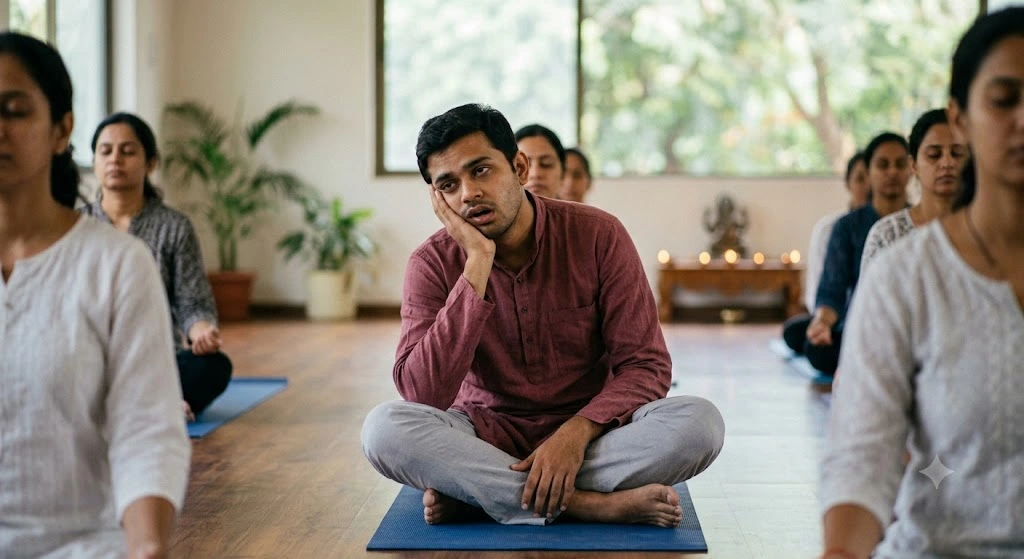

We live in an age where information is infinite, yet attention is a scarce currency. We can stream high-definition visuals from space, traverse virtual landscapes, and communicate across continents in milliseconds. Yet, when instructed to sit quietly in a comfortable chair, close our eyes, and do nothing for ten minutes, millions of us encounter an agonizing wall of frustration.
Meditation, we declare, is boring.
It feels like watching paint dry on a wall that isn’t even painted. But this boredom isn’t a flaw in meditation; it is a symptom of a deeper cultural condition. By branding the simple act of stillness as uninteresting, we shut the door on a profound dimension of human existence: the subtle mechanics of internal energy, expanded awareness, and life beyond the immediate physical senses.
The Neurological Trap: Why Stillness Feels Like Failure
To understand why meditation feels so tedious, we have to look at how our brains are wired. The modern world functions on a constant stream of high-dopamine inputs. Notifications, fast-paced video cuts, background music, and endless scrolling keep our neurological systems in a perpetual state of anticipation.
When you suddenly pull the plug on this constant stimulation, your brain panics. It enters a state of sensory withdrawal. In the absence of external noise, the brain’s Default Mode Network (DMN) — the region responsible for self-referential thought, worrying about the future, and replaying past mistakes — goes into overdrive.
Constant Stimulation → Sudden Quiet → DMN Hyperactivity → Impatience & “Boredom”
What we call “boredom” is actually impatience in disguise. It is the mind throwing a tantrum because it isn’t getting its regular fix of quick rewards. Because we aren’t taught how to navigate this uncomfortable transition zone, most people open their eyes after three minutes and conclude, “Meditation just isn’t for me.”
Beyond the Physical: The Energies We Ignore
The irony of abandoning meditation due to boredom is that stillness is not an end point. It is merely the entryway. Beyond the initial boundary of fidgeting lies a massive ecosystem of human subtle anatomy and energy that standard physical sight completely overlooks.
For thousands of years, traditions across the globe have mapped these non-physical dimensions. Whether described as Prana in Eastern philosophy, Qi in Traditional Chinese Medicine, or simply the bio-electromagnetic fields recognized by modern physics, human beings are far more than mere flesh, bone, and chemical reactions.
| Dimension | Standard Perception | Subtle Perception (Via Deep Stillness) |
|---|---|---|
| Focus | External stimuli (screens, tasks, noise) | Internal mechanics (breath, pulse, nerve tone) |
| Sensation | Physical contact and sight | Energy flow, warmth, systemic resonance |
| Mindset | Reactive and fast-paced | Observational, expanded, present |
When we refuse to sit through the initial discomfort of quietness, we miss out on experiencing these subtler aspects of reality:
- The Bio-Electromagnetic Spectrum: Every heartbeat, muscle contraction, and neural firing generates a measurable electrical field. Deep quiet allows us to feel these micro-currents within our own nervous system.
- Resonant Frequency: When the mind calms down, the body’s internal rhythms — including heart rate variability, respiratory rates, and brainwave frequencies — begin to synchronize, producing a state known as coherence.
- Intuitive Perception: Beyond logical thought lies direct intuitive insight, a clear, unclouded knowing that usually gets drowned out by daily mental chatter.
Why People Hesitate to Explore “The Unseen”
If there is a whole universe of internal experience waiting behind closed eyes, why aren’t more people eager to explore it? Why do we stay anchored to the surface level of physical reality?
1. The Comfort of Tangibility We are conditioned to trust only what we can touch, see, or measure with basic instruments. Exploring internal energy fields sounds abstract, unscientific, or overly mystical to a mind trained purely in physical materialism. Recognizing that there are forces and aspects of consciousness beyond our immediate senses requires a willingness to step into the unknown.
2. Fear of What Lies Beneath Busy schedules serve as a convenient shield. As long as we stay continuously occupied, we don’t have to confront unresolved emotions, unexamined fears, or existential questions. Sitting in absolute silence strips away those distractions, forcing us to face ourselves completely raw. For many, that prospect is far more intimidating than boredom.
3. Misconceptions About the Goal Many view meditation as a stern chore meant solely for stress management, like brushing your teeth for the mind. When treated as a rigid obligation rather than an active, curious exploration of one’s own consciousness, it naturally loses its appeal.
Reframing Stillness: From Boredom to Discovery
To break past this barrier, we have to shift how we think about meditation. It isn’t a passive waiting room. It is an active laboratory.
Meditation is not about forcing your mind to be blank. It is the art of tuning into frequencies of your environment and body that are usually drowned out by daily noise.
Think of it like adjusting a radio dial. If you only listen to the loudest, most aggressive station on the frequency band — the physical, fast-paced world — you’ll never realize that dozens of other stations exist right alongside it. The moment you slow the dial down and tune past the static, quieter and far richer channels begin to emerge:
Physical Noise / Daily Stress (loud, coarse signals) → Static Zone / “Boredom” (restless impulses) → Subtle Energy & Stillness (deep coherence & focus)
Crossing the Threshold
Boredom is not a sign that meditation isn’t working. It is the exact border line where real practice begins. It marks the boundary between the restless surface of the mind and the vast, unexplored depths of subtle energy beneath.
Stepping beyond what we see with our physical eyes doesn’t require complex rituals or exotic retreats. It simply takes a willingness to stay seated past the initial impulse to check your phone. When you learn to sit through the static, the noise recedes, revealing a dynamic, deeply interconnected reality that was waiting there all along.
At Vimoksh, we guide you through exactly this threshold — with structured Pyramid Meditation sessions that use focused energy and guided technique to help you move past the initial “boredom” and into genuine stillness. Begin your journey in Ras Al Khaimah, UAE, or explore our Karmic Lineage Readings for a deeper dive into your inner patterns.